Dubai Metro Blue Line 2026: Everything You Need to Know — And How It’s Changing Real Estate Forever
On May 3, 2026, His Highness Sheikh Mohammed bin Rashid Al Maktoum officially inaugurated the tunnelling works for the Dubai Metro Blue Line — one of the most ambitious infrastructure projects in the city’s history. With a budget of AED 20 billion, 10,000 workers on site, and a launch date of September 9, 2029, the Blue Line is not just a transport upgrade. It is a real estate game-changer.
If you are a homebuyer, investor, or tenant in Dubai, this project directly affects the value of property you own, rent, or plan to buy. This guide covers everything — the route, the stations, the timeline, and most importantly, which areas stand to benefit the most.
What Is the Dubai Metro Blue Line?
The Blue Line is Dubai’s third metro line, joining the existing Red and Green Lines. It will span 30 kilometres with 14 stations, serving an estimated population of one million residents by 2040. Roughly half of the route — 15.5 km — runs underground, reaching depths of up to 70 metres, making it one of the most technically complex metro projects in the region.
The line is split into two branches:
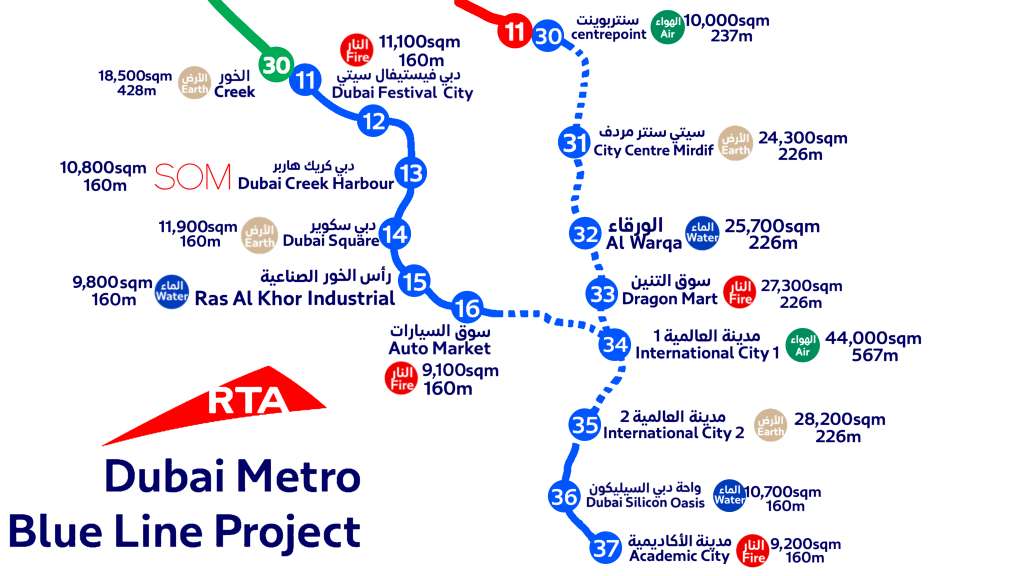
- Branch 1 (21 km): Starts at Creek Interchange Station (Al Jaddaf), connecting to the Green Line, and runs through Dubai Festival City, Dubai Creek Harbour, Ras Al Khor, International City, Dubai Silicon Oasis, and terminates at Academic City.
- Branch 2 (9 km): Starts at Centrepoint Interchange Station (Al Rashidiya), connecting to the Red Line, and passes through Mirdif and Al Warqa before merging with Branch 1 at International City 1.
The two branches meet at International City 1, which will be the largest underground interchange station in the entire Dubai Metro system.
The 14 Blue Line Metro Stations
| Station | Area | Type |
|---|---|---|
| Creek Interchange | Al Jaddaf | Green Line interchange |
| Dubai Festival City | Festival City | Elevated |
| Dubai Creek Harbour (Emaar Properties Station) | Creek Harbour | Elevated — World’s tallest metro station |
| Ras Al Khor | Ras Al Khor Industrial | Elevated |
| International City 1 | International City | Underground interchange (Y-junction) |
| International City 2 | International City | Underground |
| International City 3 | International City | Underground |
| Dubai Silicon Oasis | DSO | Elevated |
| Academic City | Academic City | Elevated |
| Centrepoint Interchange | Al Rashidiya | Red Line interchange |
| Mirdif 1 | Mirdif | Elevated |
| Mirdif 2 | Mirdif | Elevated |
| Al Warqa | Al Warqa | Elevated |
| Future Station | TBC | TBC |
The World’s Tallest Metro Station — At Dubai Creek Harbour
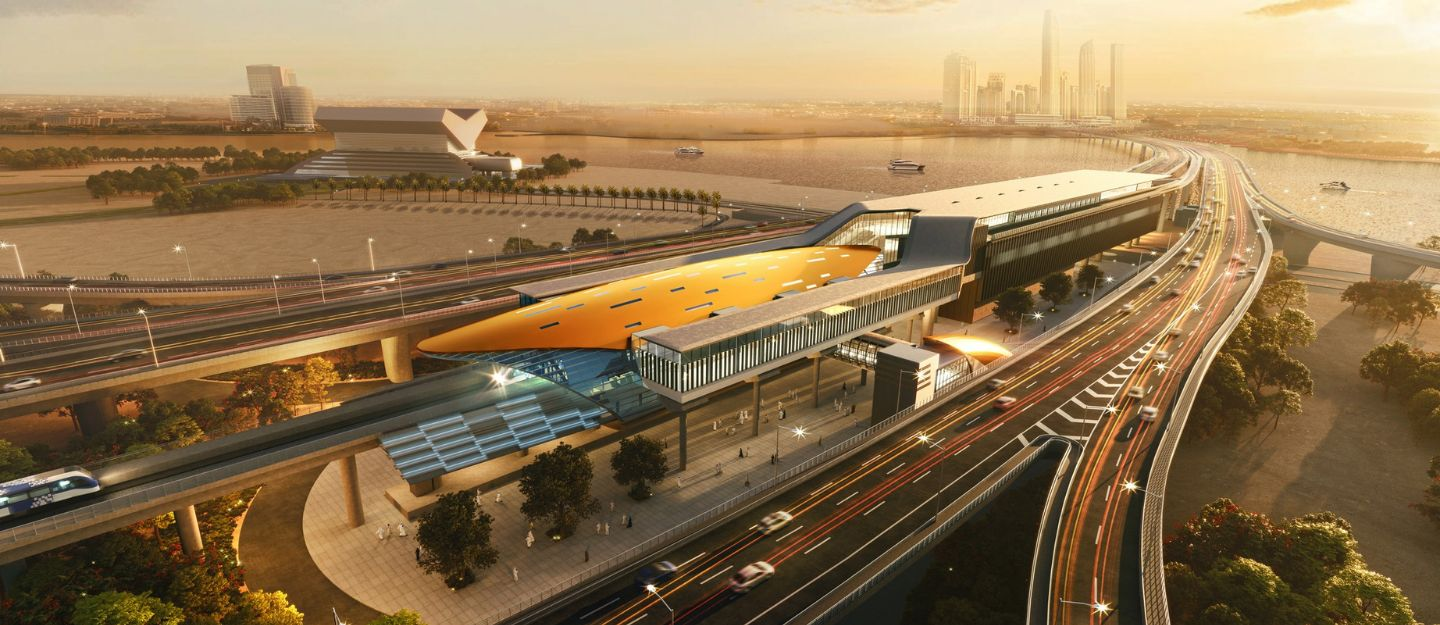
One of the most remarkable features of the Blue Line is the Emaar Properties Station at Dubai Creek Harbour. At 74 metres tall, it will be the highest metro station anywhere in the world. Designed by SOM — the same architectural firm behind the Burj Khalifa — the station covers 11,000 square metres and is built to handle up to 160,000 passengers per day.
The station’s design focuses on open spaces, natural textures, and warm earthy tones, creating what officials have described as “a sense of luxury and belonging.” It will serve the 40,000 residents currently living in Dubai Creek Harbour, with that number expected to grow significantly by 2029.
Station Design Themes: Air, Water, Earth, and Fire
The Blue Line’s stations are not just functional — they are architecturally distinctive. The RTA has confirmed that station interiors are inspired by the four elements of nature:
- Air — Three stations with soaring walls, open spaces, and light to create a sense of freedom and elevation
- Water — Two stations reflecting Dubai’s maritime heritage through flowing forms and calm colour palettes
- Earth — Grounded, natural textures symbolising community and stability
- Fire — Bold, energetic design representing Dubai’s ambition and momentum
This design philosophy sets the Blue Line apart from any metro experience currently available in the city.
Construction Timeline and Progress
| Milestone | Date |
|---|---|
| Project approved by Sheikh Mohammed | November 2023 |
| Foundation stone of first station laid | June 2025 |
| Main tunnelling works inaugurated | May 3, 2026 |
| Expected construction completion | 30% by end of 2026 |
| Target launch date | September 9, 2029 |
The September 9, 2029 opening is significant — it coincides with the 20th anniversary of the Dubai Metro, which first opened on 9/9/2009. With over 3,500 workers currently deployed and 12 active construction sites, the project is fully on track.
How the Blue Line Connects to the Wider Network
The Blue Line has been designed as a fully integrated part of Dubai’s transport ecosystem:
- Green Line connection at Creek Station (Al Jaddaf)
- Red Line connection at Centrepoint Station (Al Rashidiya)
- Etihad Rail connection planned at International City 1 — linking Dubai to the national rail network and beyond
- Future Gold Line connection at Ghubaiba (the Gold Line was approved in April 2026, running 42 km with 18 stations, scheduled for 2032)
This means residents in previously disconnected areas like International City, Academic City, and Al Warqa will soon have seamless access to Downtown Dubai, DIFC, Business Bay, and Dubai Marina — all without a car.
The Real Estate Impact: What the Numbers Say
This is where the Blue Line becomes not just a transport story but an investment story.
Historical Precedent
History in Dubai is very clear on what metro connectivity does to property values:
- Properties within a 15-minute walk of Red Line stations saw prices rise by more than 25% after the line opened in 2009
- JBR and Dubai Marina recorded price growth of 40.5% and 35.9% respectively after metro access improved
- CBRE data shows properties within a 15-minute walk of metro stations outperformed the wider Dubai market by 2.6%, with average price growth of 43.8%
- Vacancy rates near metro stations are 30% lower during market corrections — a critical buffer for investors
What the RTA Says About the Blue Line
The Roads and Transport Authority has officially confirmed an expected 25% uplift in property values near Blue Line stations once the line becomes operational. Independent analysts suggest the real number could be higher — closer to 35–40% — based on the scale of connectivity improvement the Blue Line delivers to currently underserved areas.
What’s Already Happening
The market has not waited for 2029 to react:
- Academic City studio rents have risen 43% since the November 2023 announcement
- Dubai Silicon Oasis and International City saw rental prices climb 20%+ in 2025 alone
- Properties within 500 metres of planned stations are already attracting a 15–20% rental premium over similar units farther away
Top Areas to Watch Along the Blue Line
1. Dubai Creek Harbour
Already seeing a 30% increase in property values, Creek Harbour is a long-term urban planning masterpiece. The world’s tallest metro station here will only accelerate demand. With Emaar’s major handovers scheduled for 2026 and the area’s 40,000-strong resident base set to grow, this is one of the most structurally sound investments on the route.
2. International City
Known for high gross yields of 8–9%, International City has historically suffered from poor connectivity. The Blue Line’s Y-junction interchange here is transformational. As capital values rise in response to improved access, yields may compress slightly — but total ROI combining yield and appreciation is forecast to lead the market.
3. Dubai Silicon Oasis (DSO)
A tech and business hub that has long underperformed relative to its fundamentals, DSO is now firmly on the investor radar. With metro access connecting residents directly to the city’s employment corridors, demand from young professionals is expected to accelerate sharply from 2027 onwards.
4. Academic City
Home to over 50 universities and projected to accommodate 50,000+ students by 2029, Academic City is the Blue Line’s most obvious beneficiary. Student and faculty housing demand is structural, predictable, and growing. Entry prices remain among the most affordable in Dubai, making this a compelling long-term yield play.
5. Mirdif and Al Warqa
These residential areas — home to approximately 60,000 residents each — have been entirely without metro access until now. For families and long-term tenants, the Blue Line removes the single biggest barrier to choosing these communities over more central alternatives. Demand uplift here will be steady and sustained.
6. Dubai Festival City
An established, mature community that already has strong fundamentals. The Blue Line reinforces its appeal rather than creating it from scratch — a lower-risk entry point for conservative investors seeking stability with infrastructure upside.
The Three Phases of Metro-Led Price Growth
Experienced Dubai investors understand that metro-led price growth follows a predictable pattern:
Phase 1 — The Announcement Effect (2023–2025) Buying activity increases along planned routes. Early investors move in before the broader market reacts.
Phase 2 — The Construction Visibility Effect (2026–2028) As tunnels are dug and stations take shape, market awareness increases significantly. Pricing begins to adjust more meaningfully. This is the phase Dubai is currently in.
Phase 3 — The Operational Premium (2029+) Once the Blue Line opens, pricing reflects confirmed connectivity. The highest upside has already been captured by those who moved in Phases 1 and 2.
As of May 2026, the Blue Line sits squarely in Phase 2. The opportunity has not fully closed — but it is narrowing with every passing month.
Blue Line vs. Gold Line: What Investors Need to Know
In April 2026, Dubai announced the Gold Line — a fully underground 42-km metro with 18 stations and a budget of AED 34 billion, scheduled to open in 2032. It will run from Ghubaiba through City Walk, Business Bay, MBR City, Meydan, and Jumeirah Golf Estates, also connecting with Etihad Rail.
Together, the Blue and Gold Lines represent AED 54 billion in confirmed transport investment. For real estate investors, the message is unambiguous: Dubai is building the infrastructure of a global metropolis, and property values will follow.
Key Facts
| Detail | Information |
|---|---|
| Total length | 30 km |
| Number of stations | 14 |
| Underground section | 15.5 km |
| Total project budget | AED 20 billion |
| Expected launch date | September 9, 2029 |
| Daily passengers by 2040 | 320,000 |
| Population served | ~1 million residents |
| Traffic reduction | ~20% road congestion reduction |
| Workforce on site | 10,000+ employees and engineers |
| RTA-confirmed price uplift near stations | Up to 25% |
The Blue Line Is Already Changing Dubai Real Estate
The Dubai Metro Blue Line is not a 2029 story. It is a 2026 story. Infrastructure-led price growth does not begin when the first train runs — it begins when investors recognise that connectivity is confirmed, construction is visible, and the upside has not yet been fully priced in.
For communities like International City, Academic City, Dubai Silicon Oasis, and Al Warqa, the Blue Line is the single most significant change to their investment profile in a decade. For established areas like Dubai Creek Harbour and Festival City, it is a powerful reinforcement of already-strong fundamentals.
The smart money in Dubai follows the cranes, not the crowd. And right now, the cranes are building the Blue Line.
Looking to invest in a property along the Dubai Metro Blue Line corridor? Contact our team today for expert guidance on the best opportunities available before 2029 pricing takes effect. genz-properties.com